
English| EUR
Suggested for you
More currencies
Choose a language
Oahu's North Shore hosts a predictable roster of pelagic sharks, most visible between the shoreline and the open Pacific. Understanding what kind of sharks are in Oahu helps set realistic expectations for encounters—whether you're diving, surfing, or observing from a cage three miles offshore.
Quick answer
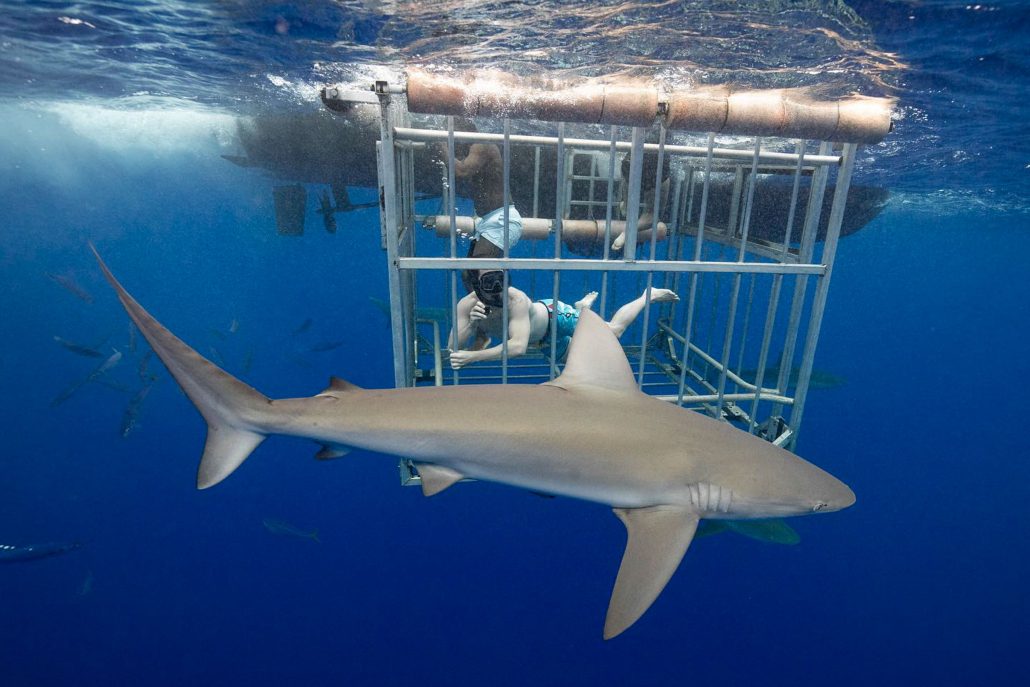
Galapagos sharks are the most common species in Oahu's North Shore waters, accounting for the majority of sightings during cage-diving tours. Sandbar sharks, tiger sharks, and scalloped hammerheads also patrol the area year-round, though in smaller numbers. All four species favor the same depth range—between 30 and 300 feet—where prey congregates and currents deliver nutrients from the open ocean.
Galapagos sharks evolved in isolated Pacific island chains, and Oahu's offshore waters remain one of their core habitats. Adults reach eight to ten feet, cruise in loose aggregations, and approach boats with investigative passes rather than aggression. The species name misleads—these sharks thrive across the central Pacific, not exclusively in the Galapagos. Their gray-bronze coloring and rounded snouts distinguish them from the more angular sandbar shark, which shares the same hunting grounds but prefers sandy bottoms over volcanic ledges. Sandbar sharks, also called brown sharks locally, grow slightly larger but move with less boldness. Tiger sharks appear sporadically, often alone, and their striped flanks and blunt heads make identification immediate. Scalloped hammerheads pass through in schools during summer months, recognizable by their signature cephalofoil and yellowish pectoral fins. All four species hunt reef fish, octopus, and squid, following prey movements rather than territorial boundaries. Oahu shark species in these waters avoid conflict with humans—documented interactions remain statistically rare relative to ocean-use hours. Morning departures from Haleiwa Small Boat Harbor between 06:00 and 11:00 align with peak shark activity, when calmer seas and strong light improve visibility for both divers and photographers. Tours operate daily, with a starting price of 90 USD per person, and the three-mile offshore journey takes twenty minutes in typical sea conditions. The sharks encountered depend on ocean temperature, moon phase, and recent storm activity, but Galapagos sharks appear on roughly ninety percent of trips. Cage-diving protocols keep participants behind galvanized steel bars while the boat crew uses fish attractant to draw sharks within camera range. The North Shore's depth profile drops quickly beyond the reef, creating an edge habitat where pelagic and coastal species overlap. That convergence explains why multiple shark types frequent the same coordinates throughout the year, independent of seasonal migrations seen in other Hawaiian waters.
“Galapagos sharks approach boats with investigative passes rather than aggression, a behavior shaped by millennia in isolated Pacific island chains.”
The waters off Oahu's North Shore host diverse shark populations that play essential roles in the Pacific marine ecosystem. Understanding these species provides insight into their natural behaviors and physical characteristics.
These sharks are commonly identified by their slender, streamlined bodies and rounded dorsal fins, often reaching lengths of up to 10 feet. They are known for their inquisitive nature and are frequently encountered in the deep, clear waters offshore.
Recognized by their exceptionally tall, triangular dorsal fins, these sharks typically remain in depths of 60 to 200 feet. They utilize the North Shore's sandy ocean floors for hunting and resting throughout the year.
These sharks feature a distinctive cephalofoil, or flattened head, which enhances their sensory perception and maneuverability. While often found in schools as juveniles, they tend to become more solitary as they reach maturity in deeper waters.
Identified by the dark, vertical stripes that fade with age, these sharks are known for their broad heads and powerful jaws. They are highly migratory and serve as vital scavengers within the local marine food web.
These sharks are easily distinguished by the white tips on their dorsal and caudal fins, which are visible even in low light. They are primarily nocturnal, spending daylight hours resting on the seafloor or within protected underwater caves.
Small to medium in size, these sharks are characterized by prominent black tips on their fins, particularly the dorsal and pectoral fins. They are typically found in shallower reef environments where they forage for small fish and crustaceans.
Public perception of shark behavior is often shaped by cinematic portrayals rather than ecological reality. Understanding these misconceptions helps clarify the nature of shark-human interactions off the North Shore.
MythSharks actively hunt humans near the shore
FactSharks are apex predators that typically view humans as foreign objects rather than prey. Most interactions occur when sharks investigate their environment, not as a result of aggression.
MythSharks are constantly aggressive toward divers
FactSharks are generally cautious around humans in the water. Divers observe them in their natural habitat, where the sharks frequently maintain distance or move past the group without interest.
MythSharks are mindless man-eaters
FactSharks follow complex biological patterns and food sources. Their presence in North Shore waters is driven by migratory and feeding behaviors rather than intent to target humans.
The best arrival window is 06:00–11:00, as morning tours offer calmer seas, better visibility, and fewer winds. Choosing early hours optimizes conditions for observing the various shark species present in North Shore waters.
Rougher seas; water temps 74–76°F
Increased northern swell may affect water clarity but peak activity continues.
Calm seas; water temps 79–81°F
Visibility is generally higher during these months with flatter ocean conditions.
—
Early departures provide the highest probability of calm surface conditions and optimal visibility for viewing sharks.
Verdict: For the clearest conditions and calmest seas, aim for weekday mornings during the transition months of April or October.
Tours depart daily from the Haleiwa Small Boat Harbor. Operations run consistently throughout the week to accommodate visitors interested in local marine life.
The shark diving tours depart from the Haleiwa Small Boat Harbor on the North Shore of Oahu. The harbor is best accessed by driving north from Honolulu via Kamehameha Highway.
Kamehameha Highway (Route 83) to Haleiwa
TheBus Route 52 or 60 to Haleiwa Town
Direct service to Haleiwa Small Boat Harbor
Plan your arrival within the best arrival window of 06:00–11:00. Morning tours offer calmer seas, better visibility, and fewer winds.
Everything you need to know about what kind of sharks are in oahu
The primary species encountered during our tours are Galapagos sharks and sandbar sharks, which are common to the deep-water pelagic environment. Occasionally, visitors may also spot tiger sharks or scalloped hammerheads in these offshore zones.
Children are welcome to participate in our tours, provided they are comfortable in the water and follow the guidance of our professional crew. Please review the booking requirements to ensure all participants meet the necessary age and swimming criteria.
Our expeditions utilize custom-built vessels to take you into the open ocean, where you can observe these apex predators from the safety of a submerged cage. This approach allows guests to safely learn about the biodiversity of the Hawaiian archipelago.
For the calmest sea conditions and optimal visibility, we recommend arriving between 06:00 and 11:00. This morning window typically experiences lower wind speeds and provides a superior experience for spotting marine life.
While sightings depend on natural patterns, the deep waters off the North Shore remain a consistent habitat for Galapagos and sandbar sharks throughout the year. These species are well-adapted to the local ecosystem and are frequently observed during our excursions.
Safety is our priority, and guests must remain inside the secure cage while in the water with the sharks. Our experienced guides provide a thorough briefing before the encounter to ensure a respectful and secure interaction with these animals.
Booking a morning departure increases the likelihood of calm seas, making it easier to observe the diverse shark species that inhabit the area. Guests arriving early often benefit from the best ocean visibility before afternoon winds pick up.